


A burger and fries is more than just a meal — it’s a slice of American tradition. Whether from a backyard grill or your favorite drive-thru, this classic combo is familiar, comforting and, for many, is a go-to for an affordable treat.
But where can hungry consumers get the most bang for their buck?
Our new research shows that a bigger burger doesn’t always mean more protein, a thinner patty doesn’t necessarily mean fewer calories, and a higher price tag can sometimes buy you more food per dollar. In a fast-changing landscape, value isn’t just about sticker price — it’s about what you actually get per bite.
That distinction matters more than ever as Americans become more selective about when and where they splurge. The World Cancer Research Fund recommends no more than three portions of red meat per week. To help consumers make smarter choices when they indulge, online lender NetCredit analyzed popular menu items across 14 major U.S. burger chains, looking beyond price alone to compare portion sizes, calories and protein. The results reveal that some familiar favorites still deliver surprising value and that knowing where to look can make an occasional treat feel more worthwhile.
What we did
To find the best value burgers and fries at major chains in America, we calculated the national average price per ounce of single-patty cheeseburgers and medium (or regular) fries at the 14 largest U.S. burger chains, analyzing published nutrition data and using home scales to weigh patties and fries.
Key Findings: Best value burgers and fries
- Whataburger’s classic “Whataburger” has the biggest patty out of the 14 U.S. restaurant chains in our study but also represents the best overall value for a burger, at $1.66 per ounce of meat.
- Burger King’s fries are around 15.6% less expensive per ounce than McDonald’s.
- The All-American Smash from Smashburger has the most protein of all — 15.7 grams per 100 grams of burger.
- Shake Shack has the best value fries at $0.40 per ounce.
Whataburger leads in burger value, despite higher prices
Identifying the best value burgers in this study wasn’t as simple as looking at the lowest prices — we wanted to make sure customers were getting good value for their dollar. So we used kitchen scales to weigh single-patty cheeseburger variants from each of the 14 biggest U.S. burger chains and then calculated the price per ounce of meat for each burger.
Even though Whataburger’s signature sandwich costs $5.92 — which is more expensive than nearly every other U.S. burger chain included in our research — and the patty also weighs the most at 3.56 oz., so it levels out to a very fair price of $1.66 per ounce of meat.
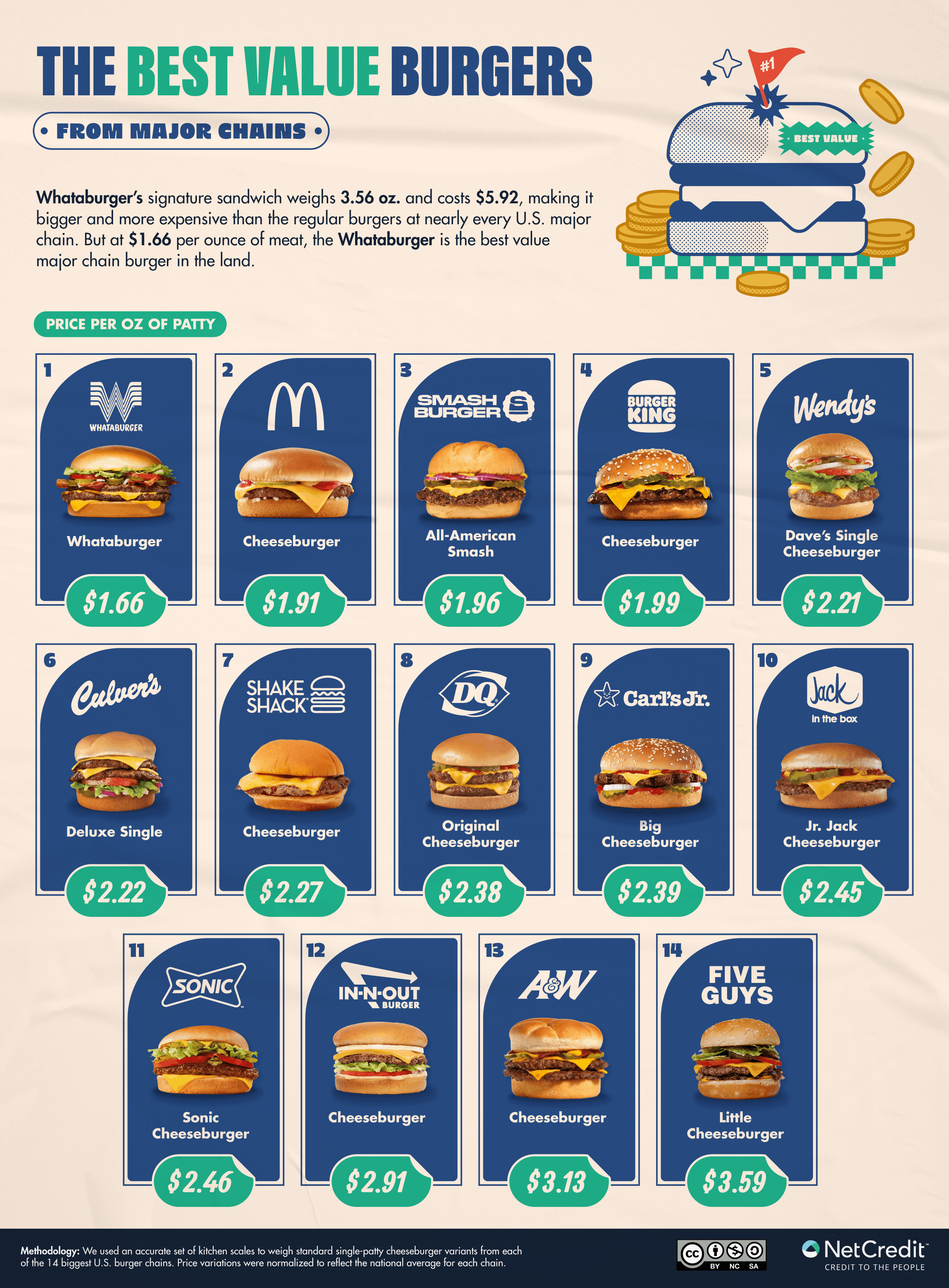
McDonald’s classic cheeseburger, on the other hand, had the thinnest patty, weighing just 1.06 ounces. Even so, it still came in second to Whataburger in overall value, since the price is so low — just $1.91 per ounce, or roughly $2.02 for the burger.
This may be connected with McDonald’s dropping its prices by about 5% a few months ago — a move designed to pull in more customers, which didn’t exactly pan out as foot traffic has continued to fall, according to foot traffic tracking firm Placer.ai.
Shake Shack delivers the most fries for the money, while Sonic offers the least
Again, finding the best value fries wasn’t about finding the cheapest fries — it was about narrowing it down to the U.S. burger chain in this study that offered the most fries for the least amount of money. We used kitchen scales to weigh a regular portion of fries from each of the 14 biggest U.S. burger chains, where regional price variations were normalized to reflect the nation’s average for each chain.
Shake Shack — despite having some of the more expensive fries on our list — had the best overall value, at $0.40 per ounce (because they do give customers a lot of fries — 6.17 ounces per regular portion). By comparison, Sonic, which came in last of the 14 places, maintains a price of $1.27 per ounce, with a total of 2.54 ounces per serving.
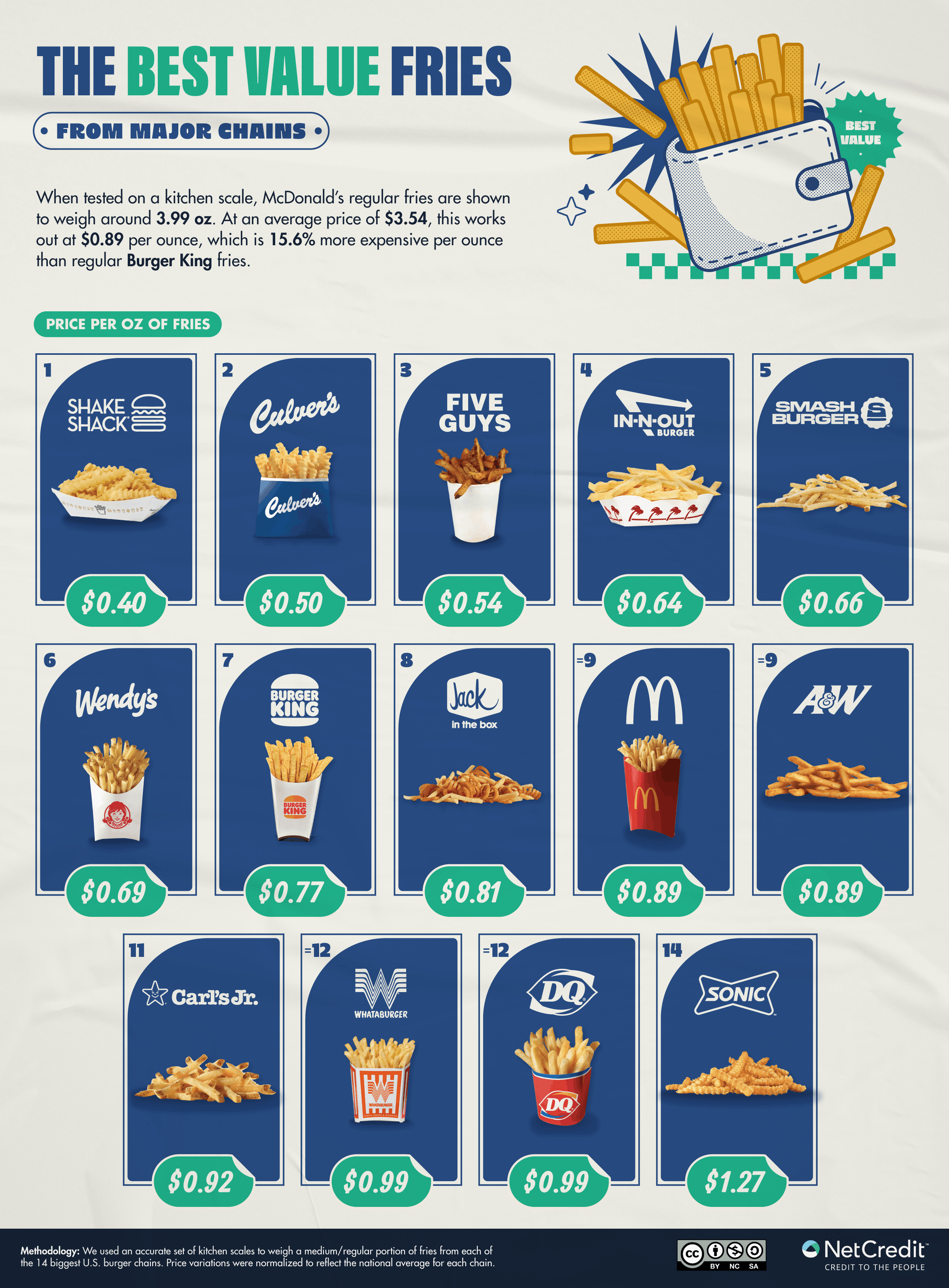
For those wondering about the classic “Burger King vs. McDonald’s fries rivalry,” we have some definite information that could settle the debate once and for all — at least in terms of value. We found that a serving of medium McDonald’s fries weighs around 3.99 oz. At a national average price of $3.54, this adds up to about $0.89 per ounce — 15.6% more expensive per ounce than regular Burger King fries.
Whataburger dominates on patty size, and the McDonald’s patty is the smallest
When we weighed standard single-patty cheeseburgers from each of the 14 biggest U.S. burger chains, the classic “Whataburger” from Whataburger topped the listing at a hefty 3.56 oz. Shake Shack’s cheeseburger trailed directly behind, followed by Dave’s Single Cheeseburger from Wendy’s.
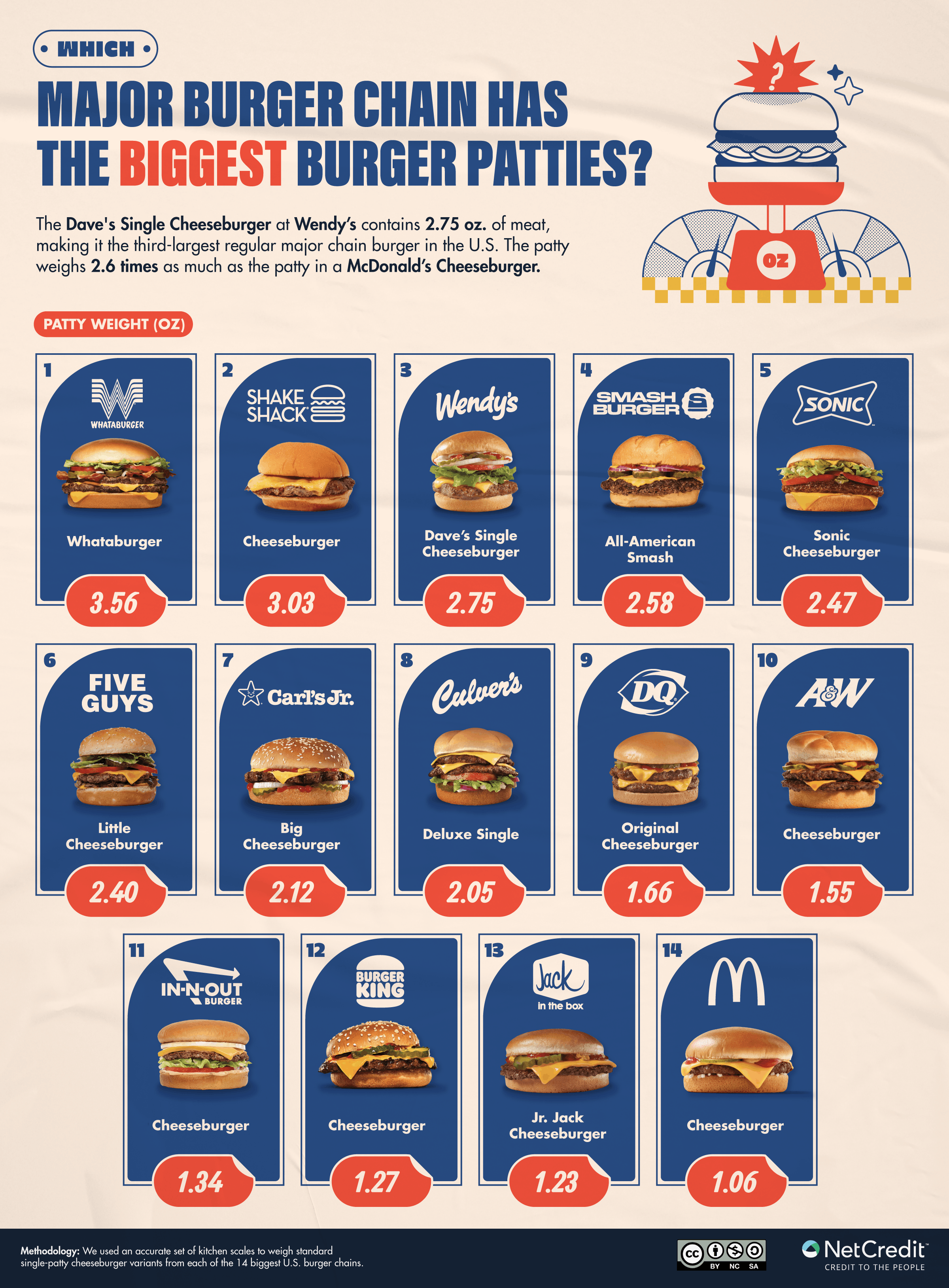
The Wendy’s patty weighs over 2.5 times as much as the patty in a McDonald’s Cheeseburger — the thinnest one on the list. This is despite the decision from McDonald’s to make its patties thicker and juicier in 2024. “We think we’re going to be able to deliver a great tasting large burger at a superior value to what [customers] can get anywhere else,” CEO Chris Kempczinski told CNN at the time.
More generally, even though some of these patties are clearly more substantial than others, this doesn’t necessarily mean they contain the most protein or calories.
Bigger doesn’t mean more protein: Smashburger beats Whataburger
In order to find out how much protein was in each of the burgers at the biggest burger chains, we looked at their nutritional menus. Perhaps surprisingly, even though Whataburger’s patty is substantially larger than others’, it has just 9.2 grams of protein per 100 grams of burger — due to the weight of the sandwich’s substantial bun and toppings.
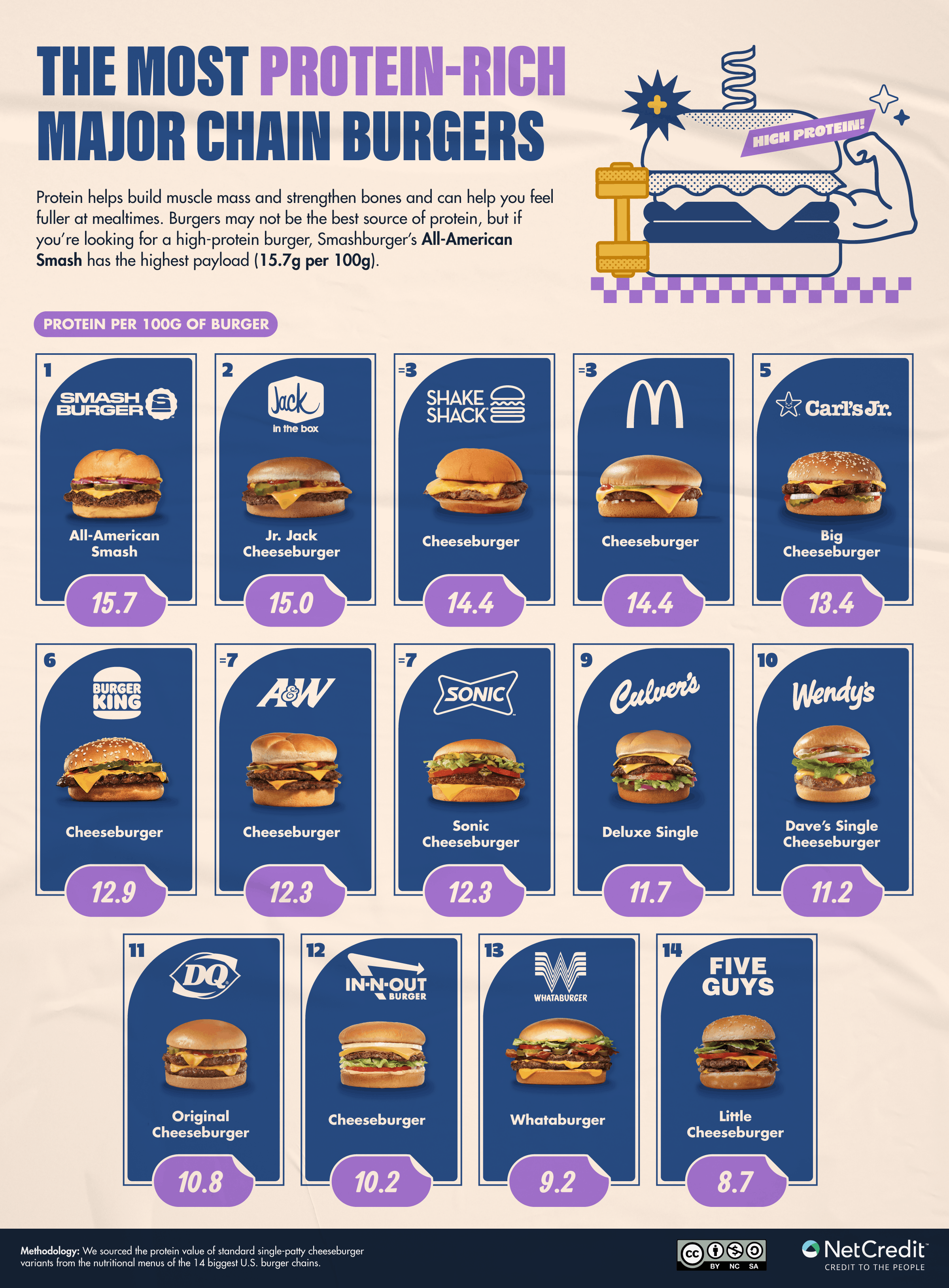
The All-American Smash from Smashburger, on the other hand, has almost double that protein amount, at 15.7 grams per 100 grams of burger. And while a cheeseburger may not exactly be the first thing you think of when it comes to a high-protein meal, protein is just what this burger delivers.
Government nutritional guidelines suggest that protein should make up about 10 to 35% of your daily calories — roughly 50 to 174 grams, depending on the person. At 15.7 grams of protein per 100 grams of burger, that equals about 11 grams of protein for one Smashburger — roughly the equivalent of two eggs.
Fry portions vary dramatically, with Five Guys far ahead
For most Americans, a burger just isn’t a complete meal without a side of fries. So we carried out manual research to find out which of the 14 top burger restaurants had the most fries, by weight, using a set of kitchen scales to weigh a regular portion of fries from each chain.
Of the chains in our study, Five Guys offers the largest regular-sized serving of fries, with 11.29 oz. per portion. That’s nearly twice as much as the runner-up, Shake Shack (6.17 oz.), and over three times as much as Whataburger’s fries (3 oz.)
That said, Shake Shack’s fries have a slightly better value per ounce since they’re less expensive than fries from Five Guys.
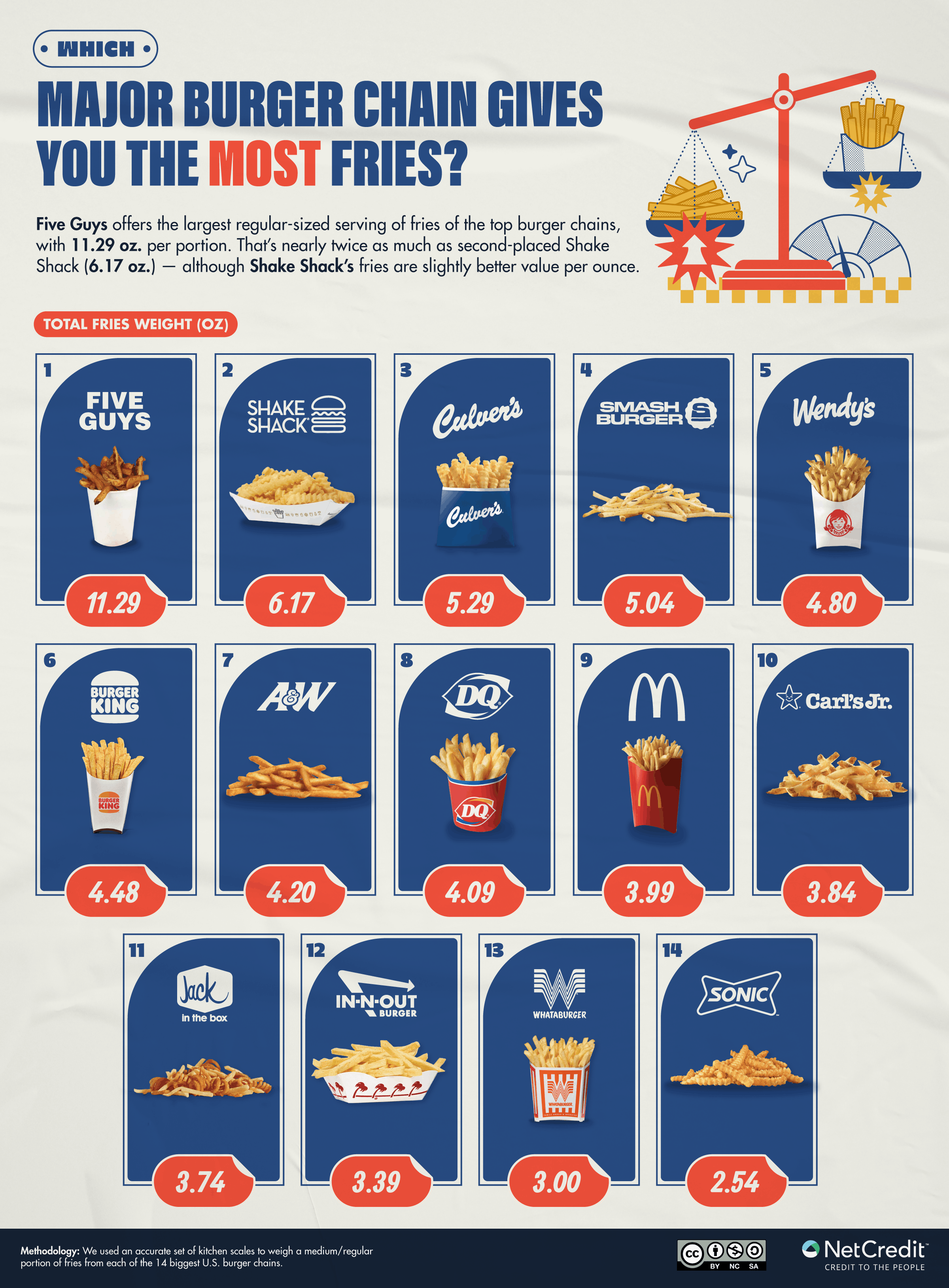
At the bottom of our list is Sonic, with fries that weigh just 2.54 ounces. In mid-2024, the restaurant chain replaced its standard fries with Groovy Fries, crinkle-cut to facilitate “optimal dipping” — a decision that has proved a polarizing choice in the french fry world.
Burgers and fries can still be a budget option
Burgers and fries have gotten more expensive, but they can still offer a budget-friendly choice for an occasional treat. Our analysis shows that value isn’t just about price alone but also about how much nutrition and satisfaction you’re getting for every dollar you spend.
If you want to make the most out of your order while keeping health in mind, consider these tips:
- Prioritize protein: Protein-rich items tend to be more filling, which can help you stay satisfied longer without ordering more food.
- Watch calories per dollar: Some menu items pack in far more calories than others at a similar price, making it easy to overpay for less nourishment.
- Be mindful of portion sizes: As we discovered, bigger doesn’t always mean better — oversized sides can add calories quickly without adding much nutritional value.
- Customize when possible: Swapping sauces, skipping extra cheese or replacing a bun with a lettuce wrap are all ways to improve nutrition without raising the price.
- Balance indulgence with value: If you’re going to skip the grocery store and treat yourself, choose menu items that deliver more food or protein per dollar so the treat feels a little more worthwhile.
- Reduce red meat overall: While a burger and fries can be a satisfying treat, it’s still important to enjoy red meat in moderation — no more than three servings per week according to the World Cancer Research Fund — to support long-term health and well-being.
Even as prices climb, with a little awareness and the right order, it’s still possible to get more out of every bite without overspending — or overindulging.
Methodology
To discover the best value burgers and fries combination in America from major chains, we calculated the price per ounce of patties and fries at these 14 largest U.S. burger chains:
- A&W
- Burger King
- Carl’s Jr
- Culver’s
- Dairy Queen
- Five Guys
- In-N-Out
- Jack in the Box
- McDonald’s
- Shake Shack
- Smashburger
- Sonic
- Wendy’s
- Whataburger
We made sure that all burgers were the standard single-patty cheeseburger variants at each chain and that all fries were medium or regular options. Both patties and fries were weighed using accurate kitchen scales after removing any other ingredients (buns, bacon, lettuce, sauce, etc.).
Additionally, we looked up the protein and calorie counts for each burger from the chain’s nutritional menus to identify the most protein- and calorie-rich burgers.
Finally, to account for any regional price differences, we normalized all product prices to reflect the national average using data from our 2025 Cost of Takeout study.
Data is correct as of December 2025.
DISCLAIMER: This content is for informational purposes only and should not be considered financial, investment, tax or legal advice.