

Americans throw away an average of $728 of edible food per year, according to the U.S. Environmental Protection Agency (EPA). But according to NetCredit’s new survey, this may be because 73% of Americans wrongly believe food label dates indicate when food should be thrown out. That figure rises to 88% for Generation Z, the youngest generation of adults, born 1997-2007.
According to the Department of Agriculture’s Food Safety and Inspection Service (FSIS), the “best if used by” date shows how long a product remains at its optimum quality. It does not indicate whether a product is unsafe to eat. (The only exception is baby formula, which should not be bought or used after its “use by” date.)
“Foods not exhibiting signs of spoilage should be wholesome and may be sold, purchased, donated and consumed beyond the labeled “Best if Used By” date.”
— Department of Agriculture’s Food Safety and Inspection Service.
To investigate how much Americans could save by reducing food waste, personal lender NetCredit combined EPA figures with population and household size data from across the country and put a total on each region’s potential wastage. And we spoke with 2,000 consumers to find out what they believe about food warning labels and which foods they’re throwing away.
What we did
We multiplied the EPA’s estimated per capita cost of consumer food waste in America by the average household size and the total population in each state and major city to find the total potentially wasted in each area. These figures assume food wastage rates are the same nationwide, so they are not a ranking of the worst food-wasting locations. Instead, they show the scale of food waste by location in relatable monetary terms.
In addition, in conjunction with Censuswide, we surveyed a nationally representative sample of 2,000 U.S. residents (aged 16+) regarding their habits and behaviors around food waste and use-by dates.
Key Findings: How much food do Americans throw away?
- Generation Z (18-28) throws away nearly one-third (31%) of the food they buy, according to our survey.
- Zoomers are also more likely than other generations to wrongly believe “food label dates can be safety indicators.”
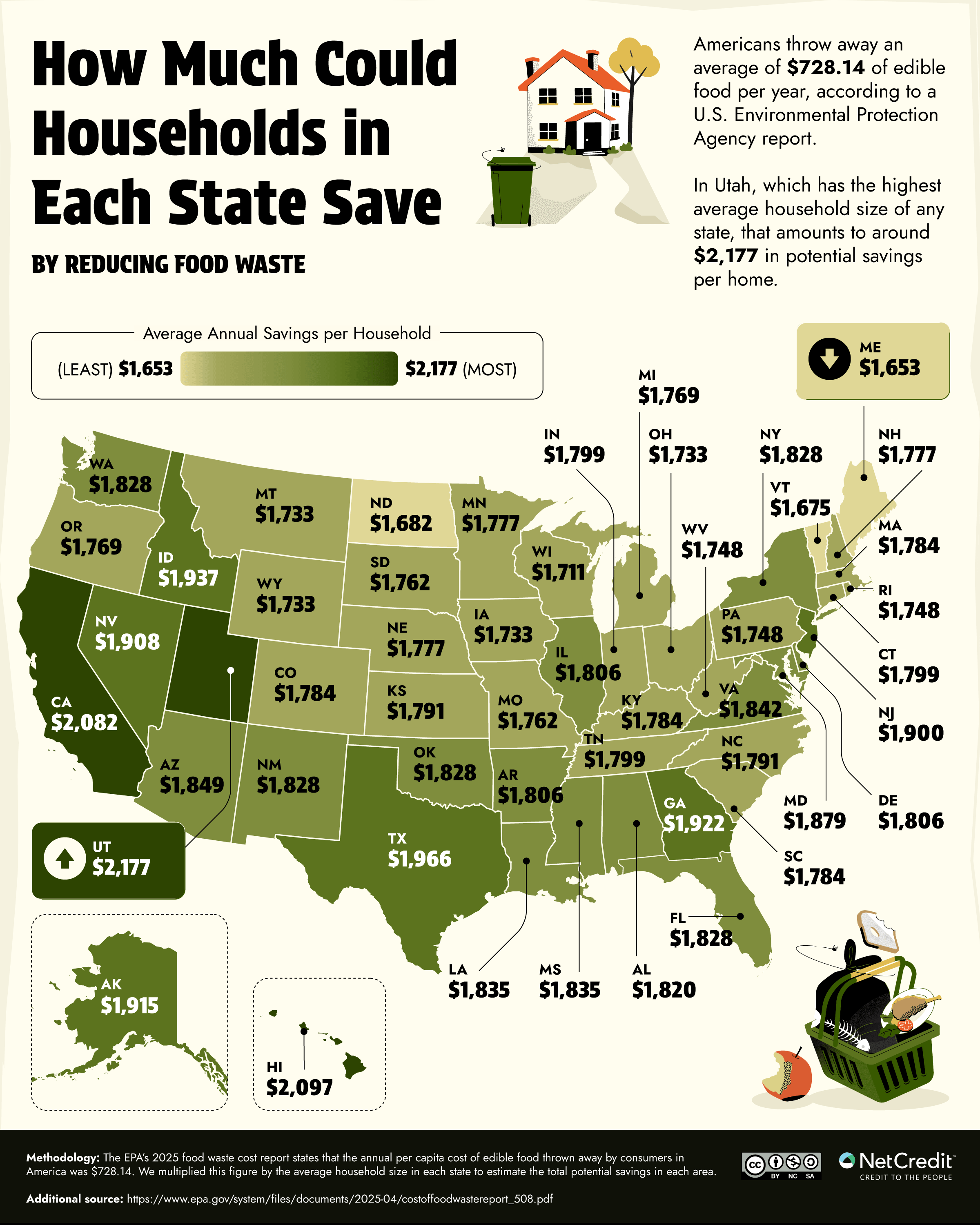
- As the state with the largest average household size, Utah could save around $2,177 per household annually by reducing food waste.
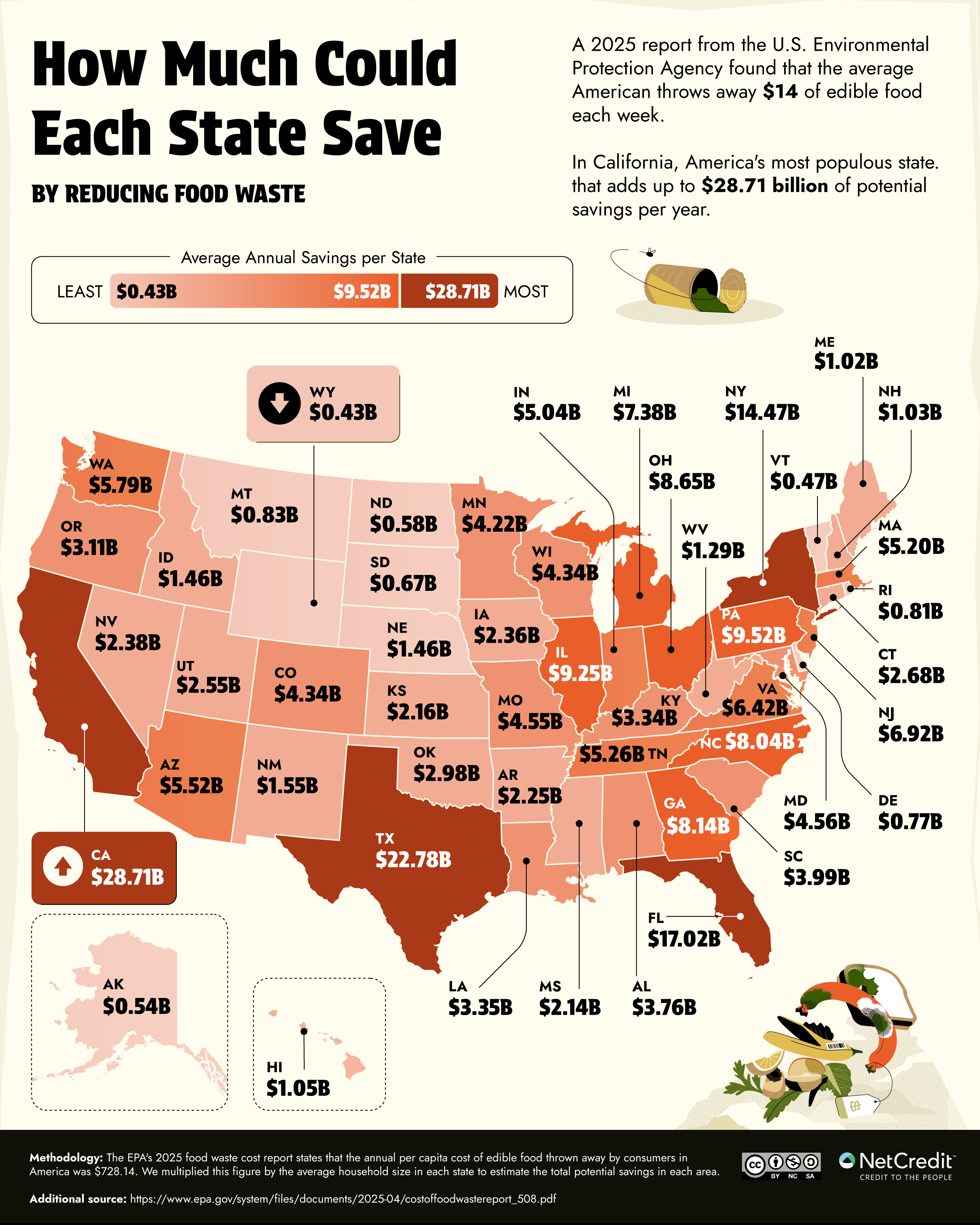
- Californians may discard around $28.71 billion of edible food each year, based on its population of nearly 40 million people.
- America’s most populous city, New York City, likely throws away $6.17 billion worth of food each year.
Many Americans throw out food after the “best by” date — but they may not need to
Many Americans believe that the “best by” dates on food indicate when the product becomes unsuitable to eat. In fact, the “calendar date tells consumers how long the product will be at its best quality,” according to the Department of Agriculture’s Food Safety and Inspection Service (FSIS). “Except for infant formula, dates are not an indicator of the product’s safety and are not required by Federal law.”
Unfortunately, this perception is a major cause of food waste in America, with the amount of uneaten food rising to 40% when unsold products are included. The Center for Science in the Public Interest (CSPI) has recommended that the relevant authorities mandate clearer wording on food date labels to help consumers make more informed choices.
We asked 2,000 consumers to estimate how much edible food they throw away each year and found that Generation Z (ages 18-28) throws away the most — around 31% on average. Millennials (29-44) aren’t far behind them, discarding 26% of the food they buy. Baby Boomers (61-79) and the Silent Generation (80+) each throw out less than 10%.
The average American throws out 22.7% of the bread they buy, which is the most for any product; lettuce (22.6%) and milk (22.4%) aren’t far behind. Chicken (21.3%) is the leading meat to get chucked, while pork (16.4%) fares relatively well.
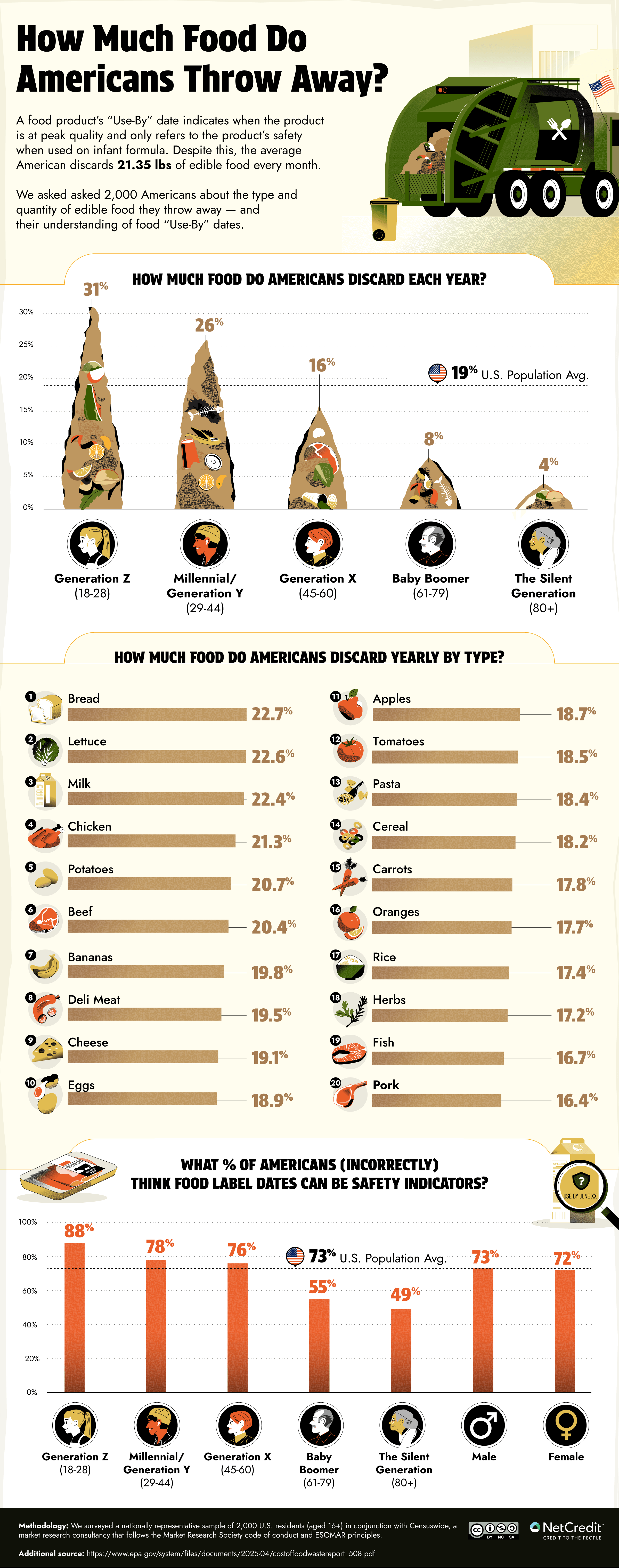
The age groups that discard the most edible food align with those most likely to wrongly believe that food label dates can indicate when the food can be safely consumed. Nearly nine out of 10 (88%) Zoomers believe this to be the case. The number of Millennials (78%) who are wrong about labeling is similar to that of Generation X (76%), although Millennials discard significantly more food.
Utah households could save an average of $2,177 each year by sniff-checking food
The EPA used U.S. Department of Agriculture (USDA) data on food waste and NielsenIQ data on food prices to determine that the average consumer wastes $728 in edible food per year.
Using this figure and census data, we calculated how much potential savings this equates to per household in each state and overall. Utah has the largest households — an average of 2.99 people per home — which gives potential savings of $2,177 per household annually. This doesn’t mean that Utah is any more wasteful than other states, but only that each household, being larger, can save more money by reducing food waste.
California has America’s largest population — 39.43 million — and so faces the largest overall bill for food thrown away: $28.71 billion per year. The inhabitants of three other states have potential savings in the tens of billions: Texas ($22.78 BN), Florida ($17.02 BN) and New York ($14.47 BN).
The government is attempting to connect food donors, including farmers and businesses that handle surplus food, with communities in need, as part of its Feed It Onward program, while social impact companies like Too Good To Go are making meaningful interventions at the ground level. Families can also make a difference by donating unused food to food banks or composting waste rather than sending it to landfills.
New York could save $6.17 BN by using edible food after the ‘best before’ date
Next, we used the same $728 figure to calculate how much money households in major cities could save by cutting food waste.
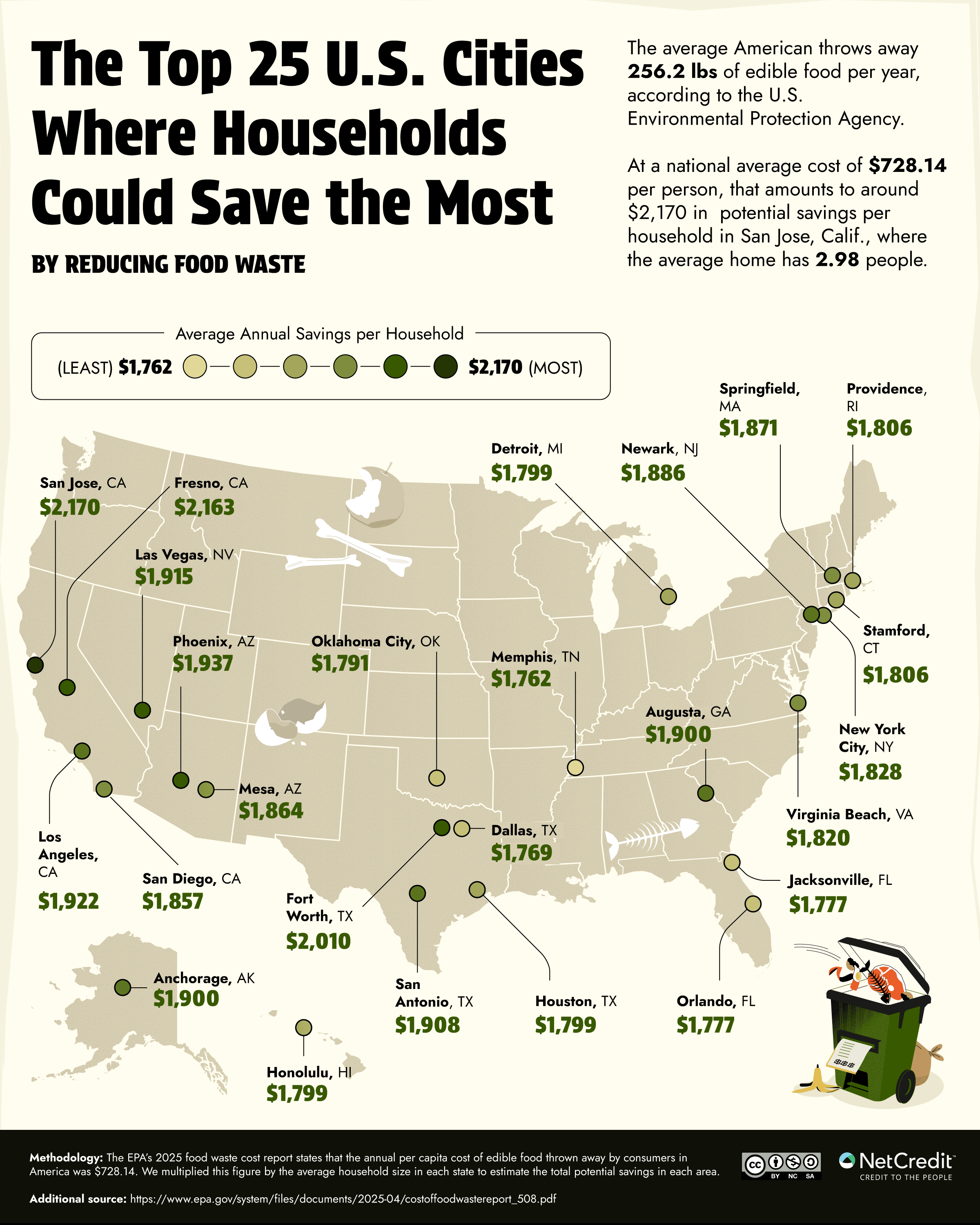
Louisville, Ky., and New Orleans, La., both have an average household size of 2.34 people, which is among the largest of major cities. This gives both cities average potential savings of $2,170 per household annually.
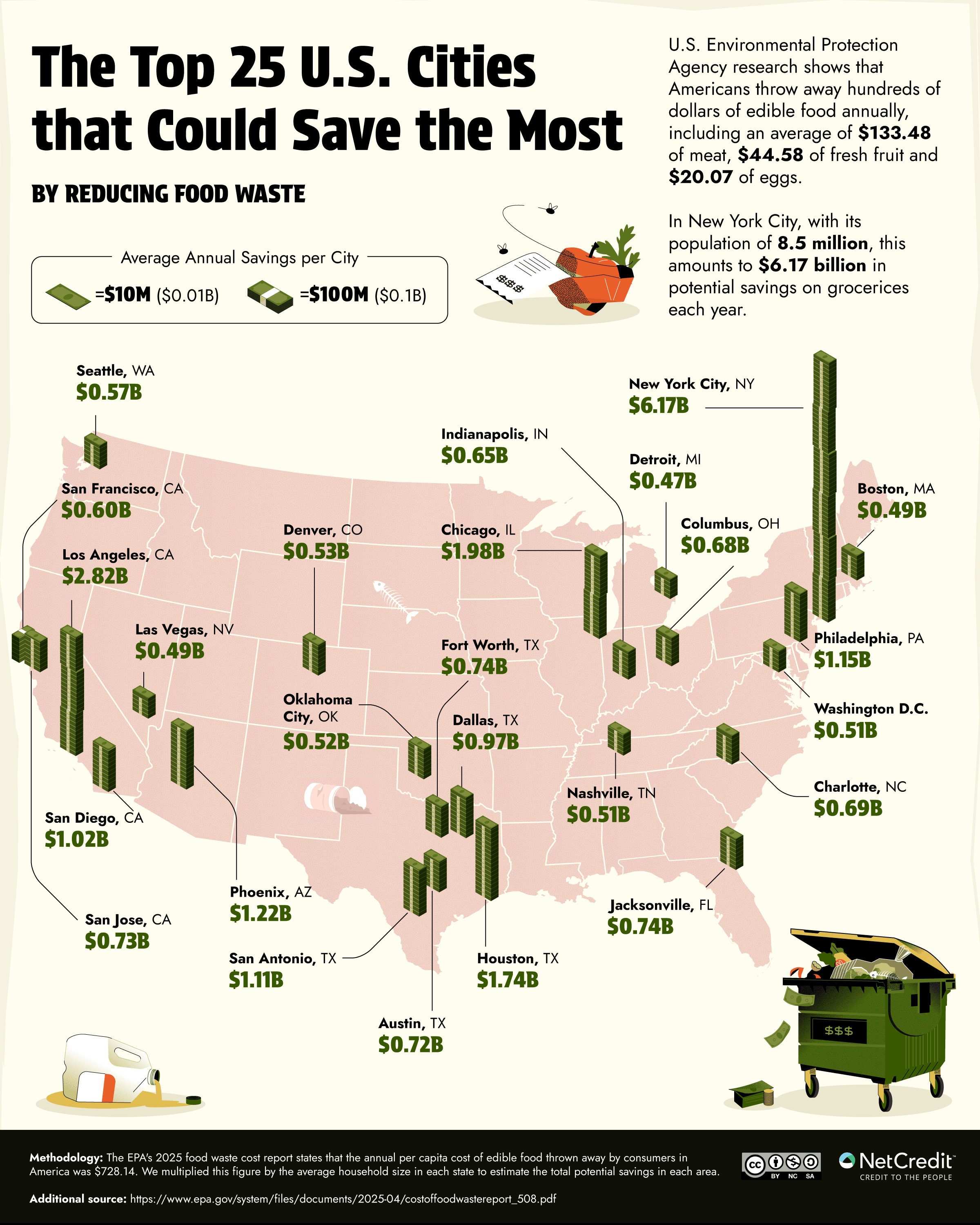
New York City’s population is 2.19 times greater than that of any other U.S. city, so likewise the value of the edible food the city’s consumers throw away. We calculate it at $6.17 BN, followed by Los Angeles at $2.82 BN. Even smaller major cities like Jackson, Miss., and Fargo, N.D., discard over $100 MN in edible food annually.
Composting food trash has been mandatory in New York City since 2024, while businesses that generate an average of at least two tons of discarded food per week are obliged to donate unused edible food and compost or recycle it through anaerobic digestion.
“We think of U.S. households wasting about a third of all their food that could be eaten,” Penn State professor of agricultural economics Ted Jaenicke told NPR. “Visually, that’s buying three bags of groceries at the supermarket and putting one in the trash on your way out the door.”
How to save money by reducing food waste
The average U.S. household wastes thousands of dollars’ worth of edible food every year, while landfills expand, the environmental cost of food soars and around 18.3 million households experience food insecurity each year.
To save money and benefit the community, consider reducing food waste with the following tips.
- Plan your meals and shopping. Figure out what you’ll need at the start of the week and buy only what’s necessary.
- Check your fridge before you shop. Before you go to the grocery store, see if you already have what you need, or if there’s anything else you can use instead.
- If you buy in bulk, store carefully. The savings from bulk buying are soon wasted if you can’t use all you buy before it spoils.
- Check the date label. Don’t buy food that you don’t plan to use before its expiry date. But…
- …Don’t discard dated food without checking yourself. Rather than take the printed date as gospel, the FDA suggests you “look at and smell the food for signs of spoilage.” Re-use leftovers when safe.
- Donate to your local foodbank. Pass unopened and unneeded food products on to those who need it by consulting Feeding America’s food bank map.
- Compost food scraps. Composting leftover food keeps unusable waste from landfills and enriches the soil in and around your neighborhood.
Methodology
To give an idea of the scale of food waste in America, we focused on one key statistic from the EPA’s Estimating the Cost of Food Waste to American Consumers report (2025), which states that the per capita cost of consumer food waste in America is $728.14.
We then multiplied this figure by the average household size and population total in each state/major city.
Note: these figures assume food wastage rates are the same nationwide, so they are not a ranking of the locations that are the worst at wasting food. Instead, it’s designed to show the scale of food waste by location in relatable monetary terms.
In addition, in conjunction with Censuswide, we surveyed a nationally representative sample of 2,000 U.S. residents (aged 16+). Censuswide abides by and employs members of the Market Research Society and follows the MRS code of conduct and ESOMAR principles.
Data is correct as of January 2025.
DISCLAIMER: This content is for informational purposes only and should not be considered financial, investment, tax or legal advice.